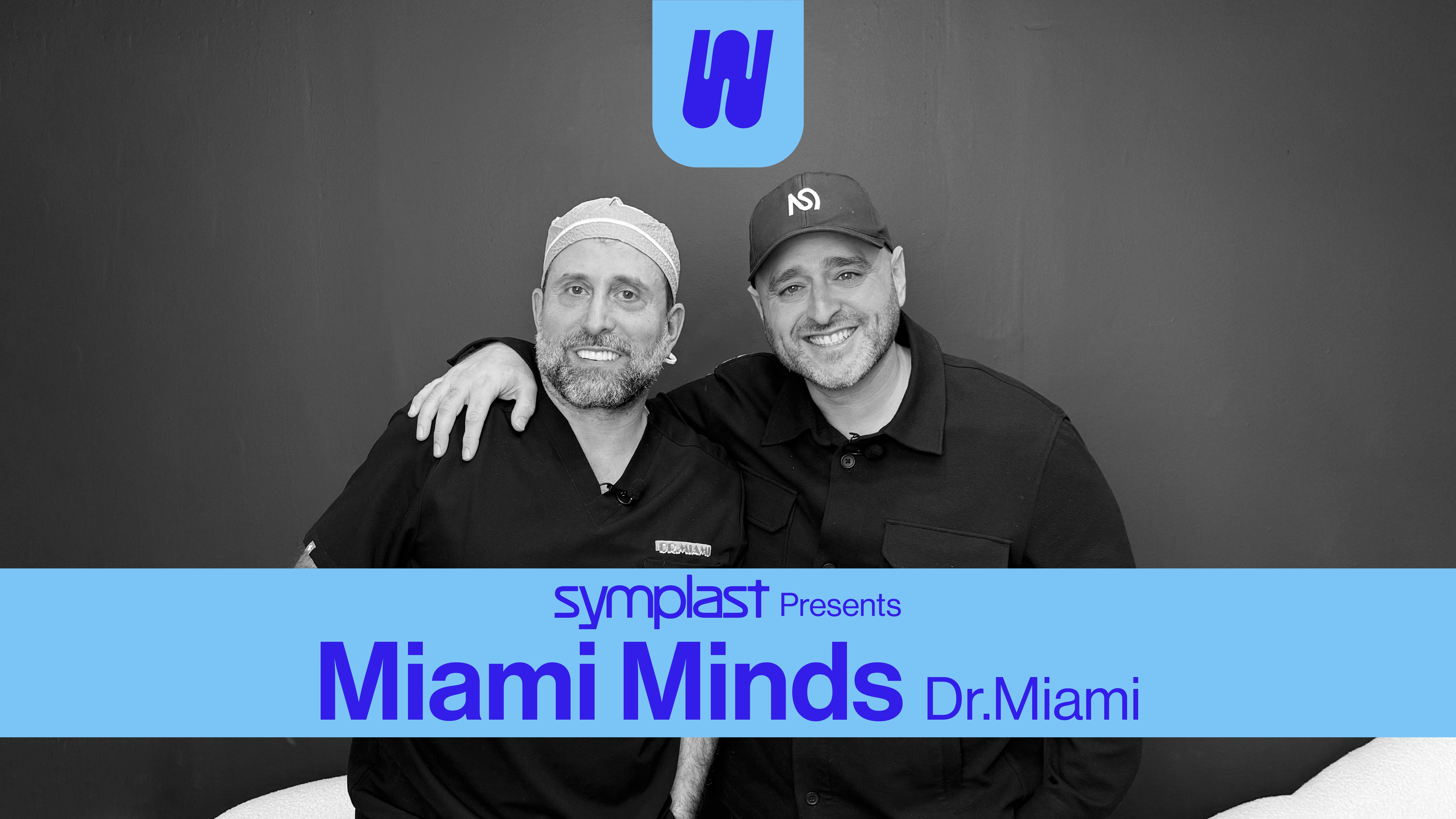
The Weekender: Dr Miami Podcast Interview, Faith, Family, Fetty Wap, & the Art of the BBL
From High School Dropout to Marketing Genius to the Surgical Disruptor.
For less than the cost of your matcha, subscribe to get full access. Cement your status as an insider and support your community. We love you Miami.
If you’ve ever scrolled through the world of Dr. Miami, you know it isn’t just “a medical practice.” It feels like a universe, unfiltered, cinematic, and wildly intentional. A place where the rhythm of the operating room meets radical transparency, demystifying an industry that once kept its doors firmly closed.
That feeling was built by Dr. Michael Salzhauer.
Michael’s story starts the way the best ones do, not at the top, but with a kid from Rockland County, New York, who found his footing at a community college and never looked back. Fueled by a childhood dream of surgery and a defining moment watching a Park Avenue doctor restore his wife’s lip after an accident, Michael understood early what most doctors never do: plastic surgery isn’t just medicine. It’s the art of transformation. And transformation demands obsession. He is, first and last, a doctor. One who studies relentlessly, refines his technique with every procedure, and holds himself to a standard that has nothing to do with the camera. The results speak before the brand ever does.
In our conversation, Dr. Miami pulls back the curtain on what it actually takes to build a global brand. He arrived in Miami for residency with $30,000 in a brown paper bag and a vision. In the early days, he’d spend Saturdays running a laser hair removal machine in the back of a Boca hair salon to support his family and because his mentor taught him the first principle of building something real: you do whatever it takes to earn the right to grow.
Then came the insight that changed everything. “Michael Salzhauer” was a name. Dr. Miami was a brand. He studied how Hip-Hop icons like Dr. Dre and his favorite Fetty Wap, built identities that transcended their craft, and applied that same thinking to medicine. He traded the sterile white coat for something more powerful: genuine connection. Because the patient he was building for, a young mom considering a procedure, wasn’t searching for clinical. She was searching for someone who understood her.
And here’s where the story gets interesting, because Dr. Miami is, at his core, a walking contradiction. He is the undisputed king of BBLs, the surgeon behind some of the most talked-about body transformations in the world. He is also an Orthodox Jew and a devoted family man, someone whose life off-camera is defined by faith, Shabbat, and the rhythms of a deeply traditional home. Most people would see tension in that. Michael sees alignment. The same discipline that governs his religious life governs his craft. The same commitment to his family drives his obsession with building something worthy of his name.
What followed was one of the most counterintuitive moves in modern medicine: the discipline of the strategic “No.” While most doctors chase volume by trying to serve everyone, Michael narrowed his focus exclusively to the 18-to-50 demographic. He walked away from revenue to build something rare, a specialty so refined it became unassailable. He chose depth over breadth, and it made all the difference.
But make no mistake, underneath the brand, the Snapchat filters, and the viral operating room content lives a serious entrepreneur and a marketing genius. Dr. Miami didn’t stumble into cultural relevance. He engineered it. He saw social media not as a tool but as a medium, and he built a content strategy that turned a surgical practice into a global personality. He understood, before almost anyone in medicine did, that attention is the new currency, and that the doctor who owns the conversation owns the market.
Behind the brand is a builder who obsesses over the details. Dr. Miami architects every touchpoint of the patient journey, from the first phone call to the final follow-up, using service focused systems like Symplast CRM to deliver service and hospitality beyond his patients expectations. Because he understood something essential about the era we’re in: in retail medicine, people aren’t just buying a surgery. They’re buying an experience. You can buy a diamond in the jewelry district, or you can walk into Cartier. Dr. Miami built the Cartier.
He built a world, and proved that the most powerful brand in any industry is always built on the same foundation: the courage to be exactly who you are, contradictions and all.
Click below for the full length interview with the great Dr. Miami.
What is your name and what do you do?'
My name is Dr. Michael Salzhauer, also known as Doctor Miami. I’m a board-certified plastic surgeon based in Miami, Florida.
How long have you lived in Miami?
I’ve lived in Miami since 1996, so it’s been about 30 years.
Where do you live?
I live in Bay Harbor Islands.
What is your morning routine?
I wake up around 5:00 AM. Then I go to the gym in my office and work out, shower, and go to synagogue to pray. Prayer starts around 6:50 AM, and I’m done by about 7:30 AM. After that I check on my patients at the hotel, then start my surgery day, consultations, and content creation.
How do you take your coffee?
I don’t drink coffee. I’m already like a switch stuck in the ON position.
What’s a hidden gem in Miami more people should know about?
The Bal Harbour walking path. It’s beautiful and a great place to walk along the water.
How do you show your creativity?
Through social media and AI. Recently I even created a Doctor Miami Broadway-style musical using AI tools like Suno and ElevenLabs.
What personal experience has shaped your creative journey the most?
When I was 19 years old, I saw a book of before-and-after plastic surgery photos.
Seeing how someone’s appearance could be transformed like that completely changed my life and made me want to become a plastic surgeon.
What is one piece of advice you would give your younger self?
Control the controllable. You can’t control what other people do or what happens around you, but you can control how you respond.
What is your happy place?
My happy place is the operating room. When I’m performing surgery, I’m completely focused and doing the thing I love most.
What do you believe?
I believe deeply in God. I’m an Orthodox Jew, and my faith is a very important part of my life. I believe that life has purpose and meaning, and things happen for a reason.
Keep your SPF high and standards higher, see you at the beach.