
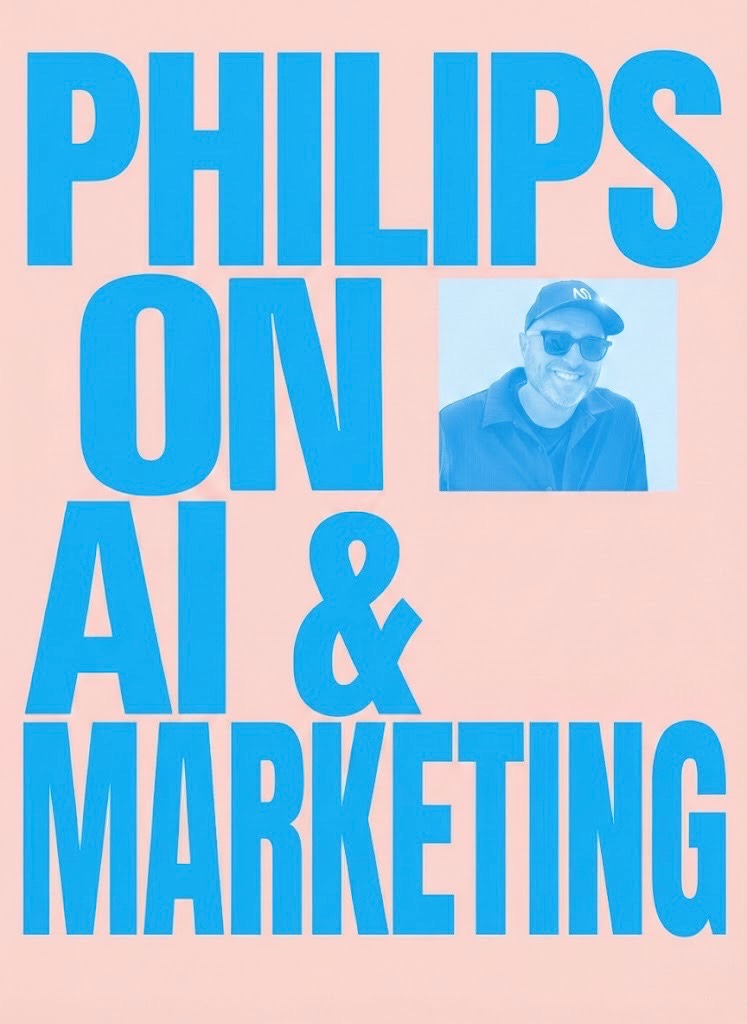
The Weekender: My Honest Take on AI, Marketing, and What Comes Next.
Something big is happening, and most people are going to be blindsided by it.
Matt Shumer, co-founder and CEO of Otherside AI, put it plainly in Fortune this month: “we are in the this seems overblown phase of something that is anything but.” The part of his post that hit hardest wasn’t the sweeping predictions about the future of work. It was something more immediate: the gap between what people think AI can do and what it’s actually doing right now has never been wider.
If you played around with AI in 2023, were underwhelmed, and moved on, you are making decisions based on a completely different technology than what exists today. The models have changed that dramatically. What felt like a novelty 18 months ago is now, a competitive weapon. And one area where that gap is most consequential, and most overlooked, is in marketing.
It’s not the corporate, Fortune 500 version of marketing that will be impacted first. It’s your version. The restaurant group, the boutique hotel, the retail brand, the real estate firm. The small and mid-sized businesses that are the backbone of cities like Miami. I started my company The Marketing Department to serve these businesses years ago. The idea being that the traditional approach to marketing does not work and that there had to be “a better way to breakthrough.” Little did I know that statement was about to be magnified 10000x. There is now a much better way to breakthrough than I ever imagined, more efficient, more impactful, and more powerful than any agency on earth.
So let’s talk about it directly.
Marketing teams are about to get very, very small.
For years, building a brand meant building a team. A CMO. A creative director. A social media manager. A content creator. A graphic designer. A copywriter. Maybe an agency on retainer for the bigger stuff, campaigns, shoots.
Expensive. Slow. And for most small businesses, out of reach entirely.
That model is dead.
Not because the work went away, but because AI now can handle 80% of those jobs. The people you still need are the ones who can think strategically, orchestrate your AI, creative direct, and have real relationships. Everything that is repeatable? AI does it faster, cheaper, and without a benefits package.
Creative direction by humans. Creative execution by AI.
You still need someone with taste. Someone who understands your brand, your customer, who you are and who you want to be. That doesn’t go away, if anything, it becomes more valuable.
But the person who spent three days turning a creative brief into finished content? That’s now three hours, or sometimes 3 minutes. The mood board, the copy variations, the visual concepts, the first five drafts… AI can execute them all. The human edits, elevates, and approves. Your creative output and efficiency goes up dramatically. Your headcount doesn’t have to.
Strategy by humans. Detailed execution by AI.
The strategic questioning (where is this brand going, what does it stand for, how does it show up in the world) is a human job. But the entire team that helps you think, brainstorm, decide, they are now available 24/7/365 for less than one hundred dollars a month. This is not an exaggeration.
But the execution plan? The content calendar, the campaign rollout, the messaging framework, the 90-day social strategy broken down week by week? AI can easily build that in an afternoon. What used to take an agency two weeks, can now take a founder or CMO with a clear vision and an understanding of the platforms a fraction of the time.
Relationships by humans. Analysis by AI.
The best businesses have always been built on real relationships, with customers, collaborators, and community. A genuine connection, a room where the right people meet, a brand that makes someone feel something, that’s irreplaceable. Clients want to speak to people to get answers, to get service, to get confidence. There is real skill in being able to speak intelligently to business leaders or partners and make them feel confident, comfortable, and understood.
AI can’t do the relationships and won’t be able to meet for lunch, but it can do all the analysis and prepare the information. It can tell you what content is resonating and why, what your audience actually cares about, where the gaps in your brand story are. The insight that used to require a team now lives in a prompt.
Let’s talk about organic social.
Why does a small business need a dedicated social media manager in 2026?
Scheduling, captioning, basic graphic creation, repurposing content across platforms, in the right hands AI can handle all of it. And soon it wont even require the right hands, just a microphone and a voice prompt. The role of a social media manager as it has existed for the last decade is fundamentally changing. What remains valuable is the person with genuine creative instincts, cultural fluency, and real community relationships. The person who just posts? That job is definitely disappearing.
Don’t get me wrong, social media is more powerful and important than it has ever been. To me it is practically the only marketing that matters, but you should be able to execute more impactfuly, creatively, and efficiently through AI.
Your website. Your app. Built by AI.
A few years ago, building a custom website required a developer, a designer, a project manager, and a couple of weeks or months. Building an app required a small engineering team and a serious budget.
Today, a focused founder can vibe code their way to a fully functional, well-designed website in a couple of hours. Simple apps are being built by non-technical people with no code and the right tools. The barrier to looking and operating like a serious brand has collapsed, alongside a significant amount of work for designers and developers, both on and off shore.
Say goodbye to photography and videography as you knew them.
A year ago, AI-generated images looked like AI-generated images. The hands were wrong, the lighting was off, something always felt slightly uncanny. You could spot it immediately.
Today? It’s good. Really good. And tomorrow (we’re talking weeks, months, not years) there will be no recognizable difference between AI-generated visuals and a professional shoot. To be honest you will be able to generate dozens of variations of your desired outcomes more professionally than the most expensive photographers and videographers. No business owner ever wanted to spend big money on these things, but they had to. It was table stakes. Now a restaurant owner can shoot their menu photos and then use AI to improve and expand the output 100x through photos, videos, and graphic treatments.
Think about what that means for your brand.
The full-day photo shoot which includes the photographer, the studio, the lighting crew, the stylist, the art director, and not to mention the post-production is an enormous investment for a finite set of assets. You walk away with 10-20 good shots and hope they carry you through the next six months. Now imagine taking those same shots on your iPhone, running them through AI, and walking away with imagery that looks like it was captured by a world-class photographer. Then ask AI to iterate different angles, different lighting, different seasons, and different moods in a hundred variations from a single afternoon. Turn those stills into video. Reels, campaigns, brand films. All from assets you already have.
And for the small business owner who could never afford a proper shoot in the first place? The playing field just leveled in a way that would have been unthinkable two years ago. Your iPhone and the right AI tools now give you access to visual storytelling that used to require a serious production budget.
There’s still a place for the real thing. Like the Japanese concept of Wabi Sabi, there will be push back, people will start craving in person happenings and cherishing craftsmanship. This will make art more valuable and experiential moments, live events, and human connection more important, but the expensive studio shoot as a marketing staple? That era is ending. Expensive shoots will be like music videos, gone but not forgotten.
The old agency model is in serious trouble.
The traditional full-service agency was built on a simple premise: you don’t have the team, so you can rent ours. Big overhead, long timelines, high retainers, up-charging, and layers of account management between you and the actual work.
That value proposition is evaporating.
The agencies that survive will be the ones offering something AI genuinely can’t: deep strategic thinking, real creative vision, genuine relationships, and specialized knowledge of a city or industry. The ability to orchestrate AI at a level most clients can’t do themselves is a tremendously powerful skill.
The boutique strategic partner and specialist model wins.
The bloated full-service model is done.
Internal marketing departments won’t look the same either.
The classic in-house marketing team, six to ten people, defined roles, steady output is already becoming a smaller, sharper unit. One or two people with strong strategic instincts and AI fluency can now do what used to require a full department. That’s not a prediction. It’s happening.
The question for business owners is simple: are you building the team of the past or the team of the future?
The hardest part of all of this.
Here’s what nobody wants to say out loud: most people don’t know how to use these tools yet. And the gap between those who do and those who don’t is going to become one of the defining professional divides of the next phase.
This isn’t like learning new software. It requires a different kind of thinking. One must learn to direct AI the way a great creative director directs talent. Knowing what to ask for. Knowing when the output is good and when it needs pushing. That skill isn’t being taught. The people who figure it out through curiosity and iteration will have an extraordinary advantage. And that window won’t stay open long.
The most important takeaway.
AI amplifies whatever you already are.
A brilliant creative who uses AI becomes superhuman. A sharp strategist with AI operates at a scale previously thought impossible for an individual. But a mediocre thinker with AI just produces more mediocrity.
Taste, judgment, vision, and the ability to create genuine human connection don’t become less important in an AI world. They become the only things that matter. Because everything else can now be replicated. Humans are different because we have the ability to connect things that seemingly have no connection, to create something new. In my book released over a decade ago, I defined The Age of Ideas as “A point in time when individual creativity becomes the primary driver of value creation and the last remaining sustainable competitive advantage.” That time has arrived more quickly and aggressively than I ever could have imagined.
Check Out My Book, The Age of Ideas, Here
Marketing as we know it is dead.
Not dying. Not disrupted. Dead. It’s been on life support for years, slowly suffocated by social media, algorithmic feeds, and a world that stopped paying attention. AI just pulled the plug.
And here’s the uncomfortable truth that comes next: it’s going to get harder, not easier, to stand out. When every business, big and small, has access to the same toolkit, the same AI-generated visuals, the same content engines, the same distribution infrastructure, money and headcount stop being the advantage they once were. The playing field flattens entirely.
The continued democratization of platforms and tools neuters every traditional form of leverage. You can’t outspend your way to relevance anymore. You can’t hire more employees to win either. What’s left? Some combination of creativity, knowledge, and technology. That’s it. That’s the whole game now.
Marketing is now defined as your ability to amplify your strategy and creativity through content using AI based tools.
Think of AI like GPS for your marketing. You set the destination, it maps the route. You're still behind the wheel, but everything else is handled.
Keep your SPF high and your standards higher.
See you at the beach,
Follow On: Instagram + Tik Tok + YouTube
Created by: THE MARKETING DEPARTMENT
For less than the cost of your matcha, subscribe to get full access. Cement your status as an insider and support your community. We love you Miami.


