



GOOD COMPANY INTERVIEW: ILAN WAISBROD, DESIGNER BEHIND BOND ST, CAFETERIA, TAO VEGAS, W HOTELS, OPENS STUDIO IN LITTLE RIVER TO DO HIS BEST WORK.
The Man Who Designed the Rooms You Remember Just Moved to Miami to do his best work.
There is a generation of New Yorkers who came of age in a particular kind of room. A long communal table. A light they couldn’t explain. The feeling that a place knew exactly what it wanted to be and didn’t need to tell you. Republic in Union Square. Cafeteria in Chelsea. Bond Street in Noho. The 40/40 Club. The W Seoul. The MGM Skylofts and Tao in Las Vegas.
Most of those people couldn’t tell you who designed those rooms.
That’s exactly how Ilan Waisbrod wanted it.
The man who designed the rooms you remember just moved to Little River.
Ilan Waisbrod is the founder of Studio Gaia, one of the most consequential hospitality design firms of the last half century. If you have eaten at Republic in Union Square, drunk at Cafeteria in Chelsea, had your first sushi at Bond Street, or stood in the 40/40 Club or the W Seoul or the MGM Skylofts or Tao in Las Vegas, you have been inside his work. You just didn’t know his name.
That’s how Ilan prefers it.
I sat down with him this week for a full conversation — his childhood in Tel Aviv, the Israeli army, the leap to Milan with $100 in his pocket and no Italian, the fight with Jay Z, the pandemic, the decision to leave New York after thirty years, and why, at this stage of his career, he is doing the best work of his life in a small office five minutes from his apartment in Miami.
I should say something about how we got here, because it’s part of the story.
BOND ST, REPUBLIC, CAFETERIA, TAO, & W HOTELS
Years before I met Ilan in person, I knew him through books. Design books I kept for inspiration — the kind you flip through late at night looking for the feeling behind a room. His work was in those books. Cafeteria. Republic. Bond Street. I would study the photographs and try to reverse-engineer what made them feel the way they felt. I didn’t know his name the way I know it now. I just knew the rooms.
Then, years later, I got invited to consult on a project in Macau — a Playboy Mansion concept that never got built, which is its own kind of story. And there was Ilan. The designer from the books, standing in the same room. We shared meals in Hong Kong. We went to press conferences together in Macau. We stayed in touch the way you do with people you meet on the other side of the world — loosely, with genuine warmth, across a distance that makes follow-through hard.
Then life moved on. He kept building his empire in New York. I built a family and a life in Miami. A decade passed.
And then Miami brought us back together. He showed up in my feed. We reconnected. And now he has a studio ten minutes from mine, and we are figuring out what we might build here together.
That’s the version of this city I believe in. Not just the real estate and the hotel rates and the restaurant openings — though all of that matters. But Miami as a place that reunites people with unfinished business and gives them something new to make.
Before any of the restaurants, before New York, before the hotels, there was Milan.
Ilan arrived in the mid-eighties with almost nothing — a student visa, a new wife, a daughter named Gaia on the way, and a hunger that had been building since he was a child in Tel Aviv filling notebooks with invented figures. He had been pushed there by a mentor at his design school who told him plainly: you’ll get wasted here. Go.
MILAN & THE MEMPHIS MOVEMENT
He arrived at exactly the right moment. Milan in the late eighties was the center of the design world, and at the center of that center was the Memphis movement — a collective of designers led by Ettore Sottsass that included Michele de Lucchi, Alessandro Mendini, Andrea Branzi, and collaborators from Japan and the United States. What Memphis declared, loudly and deliberately, was a reversal of everything the Bauhaus had established. Form does not follow function. Function can follow form. A chair sits empty for twenty-three hours a day. It’s a sculpture. Design it like one.
The colors were saturated. The shapes were unexpected. The references were global and irreverent. And the underlying philosophy — that beauty was not an indulgence but a legitimate purpose, that the emotional experience of an object or a room was as real and valid as its utility — was something Ilan had been feeling his whole life without having the language for it.
Milan gave him the language.
He studied at Politecnico di Milano. He knocked on doors. He was taken under the wing of Alberto Scattella, a dean and architect who handed a group of international students a real commission, a new student housing building, and told them to design it while he watched. Ilan did. He kept working with Scattella after. He went to the Fiera di Milano, the furniture fair where Philippe Starck was making small exhibitions outside the main hall and nobody yet knew who he was. He met people who were building the world he would eventually inhabit.
“It was explosive,” he told me. “These designers were saying: who said it has to be this way? And just taking things and turning them upside down.”
That inversion never left him. You can find it in every room he’s ever designed, the moment where something unexpected appears, the light from a place you didn’t anticipate, the swing in the corner, the color that shouldn’t work but does. Modern, warm, playful without being obvious. The Memphis influence metabolized into something distinctly his own: hospitality spaces that felt like they had a point of view without making you feel like you were inside someone’s thesis.
A few more things that stay with you from the conversation.
He designed Bond Street before he had ever eaten sushi — one of the most celebrated sushi restaurants in New York history. The first time he tried it was at Bond Street’s opening night, when he mistook an entire mound of wasabi for guacamole. He describes what happened next with the kind of matter-of-fact humor that belongs to someone who learned long ago not to take himself too seriously.
He spent years sending emails to Adam Tihany, another Israeli designer who had made it in New York, that went unanswered. Years later, they ended up in the same hotel meeting with the Palace Hotel with the Sultan of Brunei. Tihany looked at him and said: There’s a time for everything. Come work with me when you’re done here. Two months later, Ilan did. He spent three years learning hospitality design at the highest level. It changed everything.
He designed Republic in a studio apartment with Jonathan Morr, working at night after everyone went home, with no real concept of what they were building. The restaurant ran for twenty-two years. A few weeks before it closed, he went for dinner with his ex-wife and a nineteen-year-old waitress told him it was one of the coolest, most modern restaurants she’d ever worked in. He had designed it three years before she was born.
He left New York because the pandemic broke something that couldn’t be put back. Not the city — the era. His era. The one he’d spent three decades building inside twenty-five-person offices, eight hotels on the drawing board simultaneously, running between projects and clients and deadlines. He realized that era was finished. He realized, more slowly, that he didn’t want to rebuild it.
He is now doing three projects at a time. A 16th-century building in Tuscany. A restaurant for a superstar chef in New York. A men’s club in Coconut Grove. He is sketching by hand. He is putting the music on at six when the rest of the team goes home. He is, by his own description, doing things without knowing exactly what he’s doing — the way he did when he was a child in Tel Aviv, filling notebooks with invented figures, front view, side view, top view, before he knew what perspective was.
“I think I have another ten years of doing it,” he told me. “I want to do it more in an artistic way than a professional one. Almost like an artist who wakes up in the morning, draws something, does a painting, and takes a glass of wine in the middle of the day.”
The full interview is live. Watch it. It’s one of the best conversations WGM has had.
The Mr. Miami Take: Miami keeps attracting people who have already built something significant and are now building something true. That’s a different kind of city than the one that just attracts people who are hungry. Both are necessary. But only one of them produces work that a nineteen-year-old calls modern thirty years later.
KEN GRIFFIN IS BUILDING A CITADEL CITY WITHIN OUR CITY
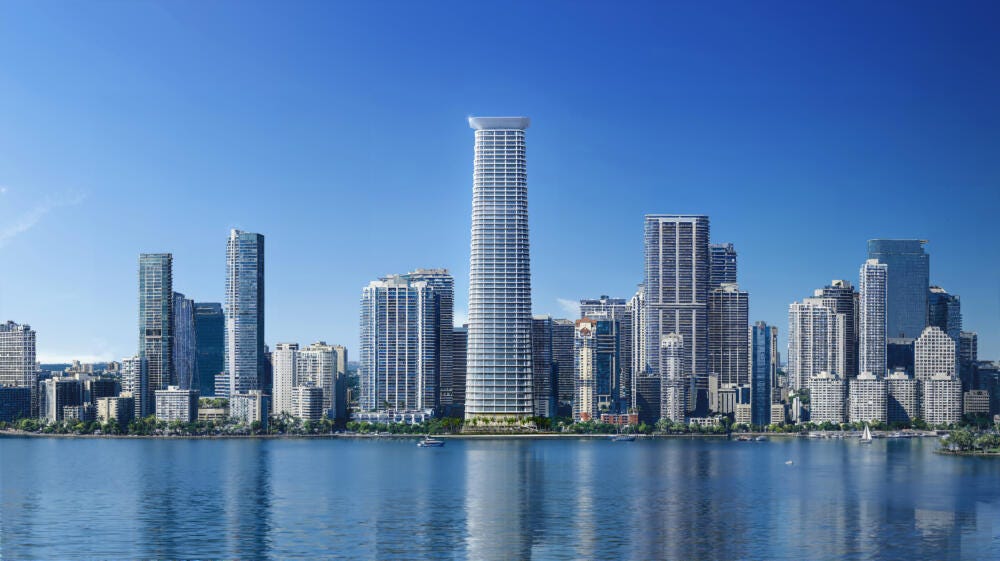
The WSJ had the story this week and it deserves more attention than it got. Ken Griffin, Citadel founder, $50 billion net worth, the most consequential financial transplant Miami has received since the city started pulling capital away from New York, just revised his plans for the 2.5-acre site at 1201 Brickell Bay Drive. He’s adding a 300-unit residential tower and a 1,420-space parking garage to a development that already includes what will be the tallest office building in Florida. The $2.5 billion Citadel headquarters supertall hasn’t broken ground yet. He is already thinking about what surrounds it.
This is not a real estate play. This is a declaration of permanence. Griffin moved Citadel from Chicago to Miami in 2022. Since then he has spent over $1 billion assembling waterfront land, commercial buildings, and estates from Miami to Palm Beach. In January he partnered with Goldman Properties to buy 545Wyn, the premier office building in Wynwood, for $180 million. He owns a private superyacht marina in Miami Beach with pools, pickleball, and crew facilities. He paid nearly $200 million combined for homes in Coconut Grove and Star Island. He is not hedging. He is building infrastructure for a life, and a headquarters, that assumes Miami is permanent.
The revised Brickell proposal adds 300 apartments and 1,420 parking spaces to the site, alongside the supertall office tower already in planning. What’s interesting about that combination, residential, office, parking at scale, is that it’s the blueprint of a neighborhood, not a building. Griffin is not just coming to Miami. He is attempting to build the kind of walkable, self-contained urban ecosystem that Brickell has been gesturing toward for twenty years but never quite delivered. When capital at this level commits to a specific block, the blocks around it reprice. When an investor of his caliber enters a neighborhood, underwriting assumptions immediately change, cap rates compress, land pricing recalibrates, and long-term institutional capital feels safer stepping in. That’s not hype. That’s how cities get made.
The Mr. Miami Take: Miami has been selling itself as a serious city for five years. Ken Griffin is the proof of purchase. He didn’t come here for the weather. He came here because he believes Miami is where the next chapter of American financial power gets written. More than 74 companies relocated their headquarters to Florida between 2020 and 2025, more than any other state. Griffin isn’t leading that trend. He’s accelerating it. The question Miami should be asking isn’t whether he’s committed. It’s whether the city can build the infrastructure, transit, schools, housing, fast enough to deserve what’s coming.

